تجربه را سفر کنین
Travel the experience
Golestan Palace
Why should we visit Golestan Palace?
The Shams-e-Amara building in this museum is the first building made of metal.
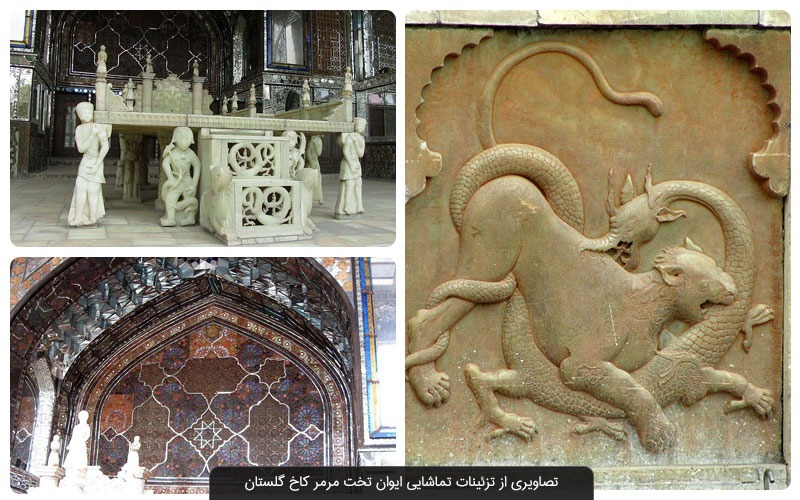
It houses a large, carved marble throne made of 65 pieces.
It has very eye-catching mirror work, stucco work, and paintings.
Golestan Palace is a historical complex that houses various palaces and royal halls. In the article, a complete introduction to the palaces of Tehran, readers are introduced to the palaces of the capital. The architectural style of this complex is derived from Iranian traditions. However, through commercial, political, and cultural interactions with European countries, it has undergone changes and developments under the influence of European neoclassical architecture. As a result, we now witness a captivating combination of Iranian and European architectural styles that fascinates every viewer and is worth seeing at least once.
One of the outstanding features of Golestan Palace is its exceptional tilework, which depicts various themes including mythology, hunting, love, war, landscapes, historical monuments, kings, courtiers, government officials, and religious motifs. These works also demonstrate the influence of increasing contact with the Western world and the patronage of artistic endeavors. They skillfully employ Western painting techniques such as visible volume, shading, and naturalism alongside traditional Iranian pictorial methods.
The exterior of the Golestan Palace buildings is not the only aspect that amazes onlookers. Upon entering these structures, you will be struck by the magnificent mirrorwork. Especially the Hall of Mirrors, which took over seven years to decorate and is truly breathtaking.
The gilded decorations on stone surfaces such as the Shams-ol-Amara and the Marble Throne add to the charm of the palace, reflecting a style popular during the Qajar era. Skilled goldsmiths of the time used metal sheets in these decorations and displayed their skills. The use of gold in the architectural decorations of Golestan Palace, along with the emphasis on durability, increases the value of this complex. In the following, we will further introduce the different parts of Golestan Palace.
History of Golestan Palace
According to the documents and travelogue of Pietro Dellavalle, the history of Golestan Palace can be attributed to the time of Shah Abbas Safavi. However, the most important period in the history of the palace is related to Agha Mohammad Khan Qajar. After defeating Lotf Ali Khan Zand, Agha Mohammad Khan came to power in 1210 AH and chose Tehran as the capital, greatly increasing the importance of the Golestan Royal Palace.
Nasser al-Din Shah Qajar, the first Iranian king to travel to Europe, was also crowned in this palace. As a result, Golestan Palace, influenced by European architecture, underwent fundamental changes and took on a new appearance. Throughout the Qajar era, this complex served as a center for governance, a royal residence, and the education of artists and architects. This made it an important hub for the production of works of art in the 19th century.
During the reigns of Mozaffar al-Din Shah, Mohammad Ali Shah, and Ahmad Shah Qajar, no major changes occurred in this royal palace. However, this period is of great importance due to important historical events such as the Constitutional Revolution and its consequences. Golestan Palace also experienced changes during the Pahlavi I and Pahlavi II eras.
Considering this, Golestan Palace has a history of more than four centuries and a significant collection of Iranian historical heritage remains in it. This palace is a valuable witness to the most important moments in Iranian history. Currently, the palace stands as an element among the disjointed architecture of Tehran, surrounded by anonymous and modern structures.
Golestan Palace Complex Sections and Museums
The various sections of the complex include:
The Complex's grounds: It includes towering trees, a pool, and fountains, and is a great place to take photos. Before you enter the buildings, be sure to enjoy the surroundings of the complex. There is also a small market near the entrance that sells handicrafts. You must purchase a ticket to enter the Golestan Complex, and keep in mind that you must purchase a separate ticket to enter each building.
Shams-e-Amara: Although there is no specific order to visit the buildings, it is best to first visit Shams-e-Amara, which was previously considered a symbol of the capital. This tall building is one of the most prominent buildings in Golestan Palace. The shape of this building is based on the model of Farang buildings that were left by Nasser al-Din Shah.
This building is very beautiful in terms of height, decorations, and design, and with 5 floors, it was one of the tallest buildings in Tehran. Shams-e-Amara is the first building made of metal. Inside the building, you will also see beautiful mirror work, paintings, and stucco work. Marble Throne Porch: This porch, called Daralamareh or Divankhaneh, dates back to the era of Karim Khan Zand and was also a place of joy for kings during the Qajar era. This porch is very eye-catching with its stucco work, stone carving, inlay work, mirror work, and inlay and latticework.
Salam Hall
The Salam Hall, also known as the Museum Room or the Coronation Hall, is located in the northwest part of the Golestan Palace. This hall was originally built with the aim of creating a museum. After Nasser al-Din Shah visited museums in Western countries, it was decided to create a similar institution in this royal citadel. As a result, the old buildings in this part of the garden, including the Museum Room and the Pond, were demolished to make way for new construction. Thus, the first Iranian museum was established in the Golestan Palace. Interestingly, photography and the concept of a museum in Iran date back to the Qajar era. The construction of the Salam Hall and other sections was completed in 1293 AH (Islamic calendar). However, the arrangement and installation of signs, as well as the completion of decorations, continued until 1296 AH. It is believed that Nasser al-Din Shah personally participated in designing the layout of the museum. Because of the Salam ceremony held in this place, this hall became known as the Salam Hall. It also earned the name Coronation Hall due to its connection with the coronation ceremonies of the Pahlavi kings.
Marble Throne
The marble throne was made by famous Isfahan stonemasons and stonemasons and installed in the porch. 65 large and small pieces of marble were used in the construction of this throne. Naser al-Din Shah's tombstone was also moved to the Golestan Palace. There is a life-size photo of Naser al-Din Shah holding a sword. The museum room on the northwest side of the Golestan Garden was built by Naser al-Din Shah as part of the first royal and state museum in Iran. Later, the museum room became known as the Salam Hall and the Pahlavi coronation ceremony was also held in this room. The Mirror Hall is also located to the west of the Salam Hall and contains a large oil painting. The construction and decoration of this hall took several years. The Vessel Hall also contains gifts from European sultans to the Qajar kings. The Windmill Mansion, which is located on the southern side of the Golestan Garden, was built during the time of Fath Ali Shah, but during the time of Naser al-Din Shah, it underwent changes and took on its present form.
In addition to enjoying this complex, it is good to know that Golestan Palace has amenities and tourism facilities such as a teahouse, Qajar-style photography, restrooms, and a prayer room.
Address: Iran, Tehran Province, Tehran, Panzdeh Khordad Street, North Side of Arg Square, Golestan Palace
Comment