تجربه را سفر کنین
Travel the experience
Khaju Bridge
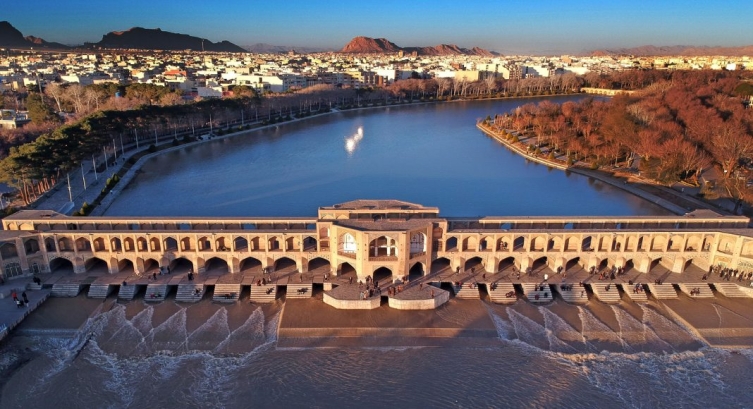
Khaju Bridge is located in Isfahan city on the Zayandeh-e-Rud River, east of Si-Ose-Poll. Khaju is a distorted form of the word Khajeh, which was named after the nobles and eunuchs of the Safavid era in the neighborhood adjacent to this bridge. This building was registered on 15 Di 1310 with registration number 111 and was built in its current form in 1060 AH (1029 AH) and 1650 AD.
This bridge is also called Shah Bridge, Baba Rokn al-Din Bridge (the route to the Khanqah and tomb of Baba Rokn al-Din and Takht-e-Folad), Hassan Beg Bridge (the name of the previous bridge that was destroyed during the reign of Shah Abbas and this bridge was built in its place), or Shiraz Bridge, and is one of the buildings of Shah Abbas II Safavid, which was built in 1060 AH. In the middle of the Khaju Bridge, a special building, known as Biglarbeigi, was built for the temporary residence of the Safavid Shah and his family and still exists today. Its arches have very beautiful painted decorations. In fact, the Khaju Bridge is more famous than other bridges on the Zayandeh Rood for its architecture and tile decorations. The bridge is 133 meters long and 12 meters wide. This bridge is also called by other names, but it is known as the Khaju Bridge because of its location in the Khaju neighborhood.
Features
Khaju Bridge is more famous than other bridges on the Zayandeh Rood for its architecture and tile decorations. Considered one of the most beautiful bridges in the world during the Safavid era, this bridge was mostly used as a dam. Between each of the eastern and western sides of the bridge, there is a building that contains several rooms decorated with paintings. This building, called the Shah Neshin, was the seat of the nobles and emirs who were called to this place to watch swimming and boating competitions on the artificial lake. A stone bench is all that remains of the king's seat. According to Professors Upham Pope and Jean Chardin, the Khaju Bridge is "a monument of Persian bridge architecture and one of the most interesting bridges in existence... in which there is rhythm, dignity, and the happiest combination of texture, materiality, beauty, and amusement". [citation needed]
The bridge has 24 spans made of carefully carved cubes and is blocked in the middle with wooden dams to block the river. Khaju is one of the bridges that played a role in regulating the flow of water in the river due to the presence of gates or sluices under its arches. When the dam gates were closed, the water level behind the bridge rose, making it possible to create a lake behind the bridge. The construction of this dam and lake was to provide a view of the buildings and gardens located in that place, and while sitting in those buildings and gardens, one could enjoy the view of the lake that was created by closing the dam. In fact, by blocking the lower openings of the Khaju Bridge, its western part becomes a small lake. During the reign of Shah Abbas II, when official ceremonies were held in the Haft Dast and Aine Khaneh palaces, the Khaju Bridge was boarded up, and a part of the river in front of the royal palaces became a lake, and fireworks were performed on the waters of this lake. In fact, the main function of this dam and boarded up was to create a lake for royal celebrations and ceremonies.
Stone Lions of Khaju Bridge
A common misconception in recent years about the stone lions of Khaju Bridge is that these lions are considered a special symbol or guardians of the bridge, guardians of Isfahan or Zayandeh Rood since the Safavid era; while the antiquity of the existence of stone lions in Isfahan, according to the works left in Isfahan, especially in religious places and even some imamzades, despite the extensive destruction of these works, in some cases dates back to the era of Jahanshah Aq Qoyunlu, and even according to the works and books published from the old cemetery of Ab Bakhshan, to the third century AH. However, according to the images left in the travelogues of Europeans, especially Chardin, as well as the narrations and research conducted on the Khaju Bridge, no sign of the presence of these stone lions and their specific temporal and thematic connections with the Khaju Bridge can be found; Because basically, the main nature and reason for the spread of these lions, especially since the Safavid era, is related to religious issues and places.
Between each of the eastern and western sides of the bridge, there is a building that contains several rooms decorated with paintings. This building, called Shahneshin, was the place for elders and emirs who were sent to this place to watch swimming and boating competitions on the artificial lake during that period. In the corners of the eastern side of the Khaju Bridge, there are two stone lions that apparently symbolized the Bakhtiari soldiers protecting Isfahan and Zayandeh-rud.
In the Encyclopedia of Takht-e-Foulad, Volume 2, in the section introducing stone lions, it is mentioned by Professor Jalal-eddin Homaei that the number of stone lions in Isfahan is twelve. These lions are in the neighborhoods of Darb Kushk, Ab Bakhshan, Darb Imam, Imamzadeh Ahmad, Imamzadeh Hamzeh, Golstaneh, Khajeh Ali Shah, Imamzadeh Ismail, Toqchi, and Takht-e-Foulad. Professor Jalaluddin Homaei narrates about the historical authenticity and original location of these lions as follows: "In Takht-e-Foulad, there were two stone lions near the old water tank of the early Takht-e-Foulad, between Tekye Shahshahan and Tekye Seyyed Mohammad Turk. In the changes made during the Pahlavi era, these two lions were moved from their place and placed on both sides of the Khaju Bridge, and they are there now." In completing this issue, based on what he heard, the professor says: "I heard from the locals that one of these lions was previously located at the Toqchi Gate, and after the destruction of the historical Toqchi Gate, they brought it to the Khaju Bridge." Therefore, there is no connection between these stone lions with a specific subject and their current location, and most of them were signs of religious places, imamzades, or gates (entrances) of the city's neighborhoods; but they have been moved from their original location according to changes and orders. Some believe that the reason for this move was the request of Abbas Beheshtian, a researcher and Isfahan scholar, for their better preservation and conservation.
The date of repair of this bridge, according to the Kufic inscription on the right southern side of the bridge, is 1290 AH by Nasrallah Khan during the reign of Naser al-Din Shah Qajar.
The method of repair of this bridge has been criticized, because in 2009, the people involved damaged the originality of this authentic Iranian building by violating the principle of preserving the authenticity and authenticity of the design and the material constituting the work and replacing the old stones of the steps with new stones.
In Poems and Writings
The poets of Isfahan have written beautiful poems about the Khaju Bridge and have praised its beauty in these poems. Among these poems is a long ode by Saeb Tabrizi describing one of the days of celebration and illumination next to this bridge. According to historians and researchers who have studied the Safavid dynasty, the purpose of Shah Abbas II in building the Khaju Bridge was to connect the two neighborhoods of Khaju and the Hassanabad Gate with Takht Folad and the road to Shiraz. Tourists and travelers who have come to Isfahan in various periods have praised the beauty of the Khaju Bridge and considered it among the eternal masterpieces of Iranian and Islamic architecture.
Destruction and Damage
On March 15, 1402, three days after the Charshanbeh Suri celebration, on the evening of March 12, 1402, it was announced that unknown individuals had caused irreparable damage to the Khaju Bridge by throwing firecrackers and homemade grenades. According to the Director General of Cultural Heritage of Isfahan Province, a large firecracker hit the roof of the Shahneshin of the Khaju Bridge. Stating that the Cultural Heritage Protection Unit was present on the night of Charshanbeh Suri, he claimed that the firecracker hit the bridge the day after Charshanbeh Suri. The commander of the Isfahan Cultural Heritage Protection Unit also denied that the Khaju Bridge was damaged as a result of the firecracker hitting it on the night of Charshanbeh Suri.
Address : Isfahan Province, Isfahan City, Pol Khajoo
Comment