تجربه را سفر کنین
Travel the experience
Naqsh Jahan square
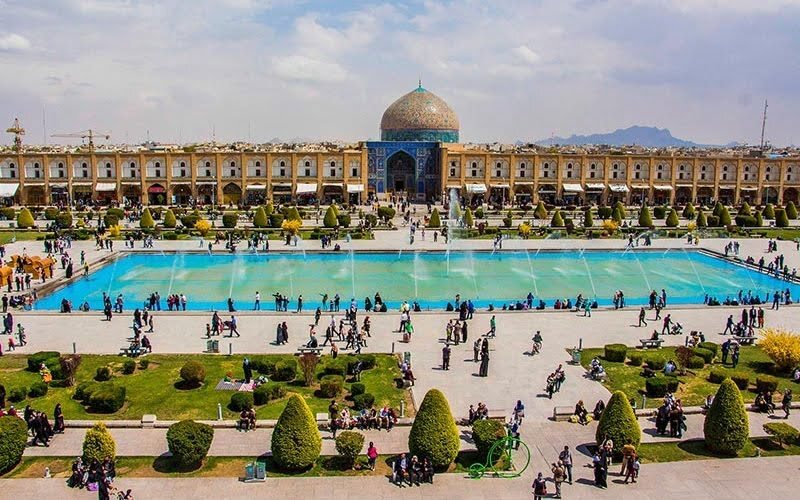
Naqsh-e Jahan Square, also known by its historical name Shah Square and after the Iranian Revolution of 1979 with its official name Imam Square, is the central square of Isfahan, located in the heart of the Naqsh-e Jahan historical complex.
The historical monuments on the four sides of Naqsh-e Jahan Square include Aali Qapu, Shah Mosque (Imam Mosque), Sheikh Lotfollah Mosque, and Qaysariyeh Gate, which is the main entrance to Isfahan Bazaar. In addition, there are two hundred two-story rooms located around the square, which are generally places to display Isfahan handicrafts.
Naqsh-e Jahan Square was registered on the National Monuments of Iran on 8 Bahman 1934 as number 102, and in Ordibehesht 1979 as number 115, it was one of the first Iranian monuments to be registered as a UNESCO World Heritage Site.
Nomenclature
After its construction, this square was named Shah Square. At the time of its registration, it was registered on the World Heritage List under the same name, and is currently registered on this list as Imam Square.
Before the Safavid period, there was a garden called Naqsh-e Jahan. During the reign of Shah Abbas II, due to the overcrowding of the surrounding bazaar and vendors, it was decided to build another square in addition to Atiq Square (or Old Square) and Shah Square. This square, which was located very close to Shah Square and behind Sheikh Lotfollah Mosque, was named Naw Square. Since the old building in Naqsh-e Jahan Garden was demolished at the same time as the construction of this square and its materials were used there, Naw Square was also called Naqsh-e Jahan Square.
Over time, both Old and New Squares were demolished and disappeared, but Shah Square remained standing. In recent years, the old square has been renovated, but the new square, which did not have the beauty and charm of the two squares, was forgotten, and its only nickname, Naqsh-e Jahan, became another name for Shah Square or Imam Khomeini Square.
Shah Abbas built the Abbasid Grand Mosque in this square, and Sheikh Lotfollah Mosque, which was said to have been a school, connected the old and new squares by extending the bazaar and adding the Qaisarieh section, and built Ali Qapu as an external facade of the government and for communication with the community.
Many tourists and world travelers who have described the city of Isfahan in the past have spoken a lot about the splendor and grandeur of Naqsh-e Jahan Square, and have recounted memories of visits by foreign ambassadors, representatives, and citizens of other countries to this square, and many historical negotiations between Iranian statesmen and foreign envoys were held in Naqsh-e Jahan Square.
During the Safavid period, there was a stream of water around the square, which entered from the alley behind the kitchen and from the Job Shah cistern located on current Sheikh Bahai Street. After going around the square and filling the ponds in front of the Abbasi Mosque and the Qaisariyeh Gate, it poured into an underground cistern in front of the Qaisariyeh Gate and went to irrigate the gardens of eastern Isfahan. The plane trees around the square were also very famous, creating a pleasant shade until the Qajar era.
Geography and Characteristics
Naghsh-e Jahan Square is a rectangular square 560 meters long and 160 meters wide.
There are two hundred two-story rooms around the square. In addition, four buildings, Aali Qapu, Shah Mosque, Sheikh Lotfollah Mosque and Qaysariyeh Gate, are also built in the middle of the four sides of this rectangle.
Contemporary History
Naghsh-e Jahan Square was registered on the National Monuments of Iran on 29 February 1935. The square was also registered as one of the first Iranian UNESCO World Heritage Sites in May 1979. The proposal of the cultural landscape issue at the UNESCO meeting for the World Heritage Sites, and the subsequent construction of the 50-meter-high Jahan Tower (with 14 floors) 700 meters away from Naghsh-e Jahan Square (and in the historical and cultural landscape of the square) in 1975 led to the issue of the square being placed on the UNESCO "Heritage in Danger" list for the first time in 1980. The main shareholder of the tower was the Isfahan Municipality, and the Isfahan City Council, in support of the municipality, condemned UNESCO's interference.
With the municipality's insistence on continuing the work, UNESCO sent inspectors to Isfahan in 2002 to visit the site. UNESCO inspectors declared that “Naghsh-e Jahan Square cannot be seen in isolation from its surroundings.” The experts added that “the skyline and historical and cultural landscape of Naghsh-e Jahan Square have been distorted and the Iranian government is obliged to take action to modify the Jahannama Tower.” Accordingly, UNESCO gave Iran until February 2004 to modify the four floors of the tower.
The conflict between the Isfahan City Council and Municipality on the one hand and the Cultural Heritage Organization and Isfahan Governorate on the other hand reached the Revolutionary Court, and even Seyyed Mohammad Khatami, the then President, was forced to intervene. Finally, with the Cultural Heritage Organization paying part of the municipality’s damages, the Jahannama Tower was modified on February 29, 2005, and its upper two floors were demolished so as not to harm the cultural landscape of the square.
Address : Iran, Isfahan Province, Isfahan, Naqsh-e Jahan Square
Comments