تجربه را سفر کنین
Travel the experience
Salty men
Discovery of the First Salt Man
In the winter of 1993, miners encountered the torso of a body while excavating and extracting salt from a mine under the hills of this area. The body had a beard and long hair and a gold earring in its left ear. The body was found in the middle of one of the mine tunnels, which was about 45 meters long. Excavations in this area began on March 25, 1993. Following the excavations, a leg in a leather boot, three knives, shorts, a silver object, a stone hook, pieces of leather rope, a sapphire, a walnut, pieces of pottery, several pieces of patterned cloth, and crushed pieces of bone were also found. Archaeologists have said about the appearance of this body that the Salt Man was probably from the nobility and princely class, because jewelry and ornaments were found on his clothes that were specific to this class, and they also have the hypothesis that he either took refuge in a cave while fleeing or fled from the field during a war and took refuge in a cave and died there, and termites ate his body, which was covered in salt.
Discovery of the Second Salt Man
Despite the exceptional discovery of Salt Man No. 1 in 1993, little effort was made to shut down mechanical extraction and cancel the exploitation of the mine. In the fall of 2004, miners again encountered the remains of a human skeleton while working with a bulldozer, which had been largely disintegrated due to the bulldozer, and by searching the miners among the disturbed soil, in addition to collecting parts of fragmented human remains, a number of objects were found, which were transferred by the exploiter to the provincial Department of Cultural Heritage and Tourism. Initial investigations into the human remains, which were later named Salt Man No. 2 after being transferred to the cultural heritage, showed that these remains belonged to a middle-aged man with an average height of about 180 centimeters who was killed during the collapse of the tunnel walls and roof.
Among the objects found with this Salt Man are pieces of baskets and wooden nails, plant ropes, and textiles.
The accidental discovery of Salt Man No. 2 and a collection of objects led to the resumption of archaeological research in the Cheherabad salt mine after 11 years; therefore, excavation of the mine began in January 2004, despite unfavorable and difficult weather conditions, in order to salvage the remaining artifacts and remains.
Discovery of the Third Salt Man
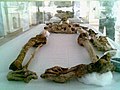
Salt Man No. 3, like Salt Man No. 2, was discovered by chance during bulldozer tailings removal by miners in 2004. Due to the fall of a very large rock of salt on Salt Man No. 3 and its discovery by a bulldozer, this body was also found in disintegrated and fragmented form. What was called Salt Man No. 3 was actually the remains of bones, clothing and parts of soft tissue of a person who, like other miners, was killed by a tunnel collapse and a multi-ton rock falling on him
Discovery of the Fourth Salt Man
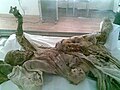
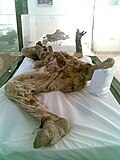
Salt Man No. 4 is the most intact and complete salt body recovered from the Cheherabad mine, and despite the damage at the time of death, almost most of the body parts of this mummy remain intact. This body consists of a set of bones and soft tissue that has completely dried out due to dehydration.
Based on the research conducted, it was determined that this natural mummy was a young boy who was about 16 years old at the time of death. The height of this mummy is 170 to 175 centimeters and there are metal rings on its ears. Its hair is short and brown in color. Interesting objects were also discovered with this mummy. One of these objects is a metal knife with a bone handle that is tied to the mummy's cloth belt in a leather sheath, and other objects include two small, intact clay jars.
One of the most important features of this natural mummy is the complete clothing that is seen on it; this clothing consists of a long top, a pair of trousers, and leather shoes.
Discovery of the Fifth Salt Man
This natural mummy was also found in the second season's excavation, with the rest of the body, except for the head, under large rocks and rubble. The shape of the body indicated that this person, like the previous examples, was killed and buried as a result of an accident that led to the destruction and collapse of the tunnel.
Unlike salt mummy number 4, most of the body tissue of salt man number 5 had decayed and disappeared, and soft tissue remained only in small parts of the hands, feet, parts of the face, chest and pelvis. The hair on the body's head is due to the environmental conditions in which the salt man was found. The low salt content in this environment and the penetration of water from the top of the mountain into this part of the mine are the main reasons for the severe decay of salt man number 5.
Discovery of the Sixth Salt Man
The sixth salt man was discovered after about 40 centimeters of excavation near the discovery site of Salt Man No. 2, with the beginning of the third season of excavation in June 2007 due to rainfall and salt washing, but due to the lack of an excavation permit and difficulty in preservation, this body has remained in the salt until now. The skull of the sixth salt man dates back to the Sassanid period.
In the third season of archaeological excavations of the Cheherabad Salt Mine in Zanjan, a delegation from the University of Bochum and the city museum, the University of Switzerland, and the General Department of Cultural Heritage of Zanjan Province are cooperating. These excavations are being carried out based on a memorandum of understanding between the General Department of Cultural Heritage of Zanjan Province, the University of Bochum, and the Bochum Mining Museum in Germany.
Storage location
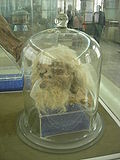
The body of the first mummy was found in the Cheherabad Salt Mine, located one kilometer south of the village of Hamzehlu in the western region of Zanjan County. The head and left foot of the first Salt Man can be seen in the Museum of Ancient Iran, Tehran. The bodies of three other Salt Men are kept in the Zolfaghari Mansion in Zanjan.
Research
Carbon-14 dating tests conducted on the bones and fabrics of the collection determined the Salt Man to be about 1,700 years old (late Parthian–early Sasanian). DNA tests showed that the Salt Man was about 37 years old at the time of death and was about 175 centimeters tall. By examining the tests conducted on the hair cells, the Salt Man's blood type was determined to be B+.
A CT scan and radiology test conducted in collaboration with Dr. Jalal Jalal Shokohi revealed that the Salt Man died as a result of a sudden fall into one of the salt mine pits and a very severe blow to the right side of the skull and face. Archaeological studies on the Salt Man complex showed that due to the special arrangement of long hair on the head and face, the presence of a gold earring in the left ear, leather boots with very delicate and artistic construction and stitching, as well as the type and technical texture of the clothing fabric, and the discovery of a silver object with the deceased, the person in question was not a simple salt mine worker, but rather a high-ranking person with a high social status, but the reason for his presence, fall, and death in the Cheherabad salt mine still remains shrouded in mystery and ambiguity.
In December 2015, Salt Men Nos. 1 and 5 were CT scanned with the approach of new discoveries at one of the scientific centers of Tehran University of Medical Sciences.
Parasitology
In a study conducted in 2012 on one of the Salt Men, who was approximately 2,200 years ago, it was found that the person had the remains of codling moth eggs in his digestive tract, which was considered a significant discovery in terms of determining the type of food at that time and the type of parasitic infection present. The presence of roundworms indicates that undercooked meat was common at that time.
The clothes preserved on the mummies of the Dozlakh salt mine in Cheherabad provide us with valuable information about the way in which fabrics were dressed, dyed, and woven in their time; for example, mummy number 4 is fully clothed, and the fabrics are in very good condition.
Ancient mining methods
A study of mining and excavation equipment and the study of the mine itself, along with information obtained from carbon-14 testing, show that in the 5th century BC (Achaemenid period), the mine was active and several mine collapses occurred in it, killing a number of miners, and the mine was in use until the 5th century (Sassanian period). The mine was excavated using pickaxes and column-chambering, and the mining method was different in the Achaemenid and Sassanid periods.
Salt Men Documentary
The documentary "Salt Men" produced and directed by Hassan Dehghan and starring Masoud Mohammadi and Mohammad Vali Foroutan was produced for 60 minutes on Zanjan Central Broadcasting.
Film Topics
This documentary deals with the bodies discovered in the ancient and historical salt mine of Cheherabad village in Zanjan province, which have been naturally mummified over thousands of years.
The documentary "Salt Men" examines the method of discovery, tools, fabrics, and clothing accompanying these bodies, which date back 1,700 to 2,800 years.
A part of the life of these men is also presented in the form of reconstruction and recreation, and issues related to scientific and archaeological topics are also examined in detail.
Address: Zanjan, Zeinbiyeh, Saadi St., West Zeinbiyeh St.
Comments