تجربه را سفر کنین
Travel the experience
Thirty-three bridges
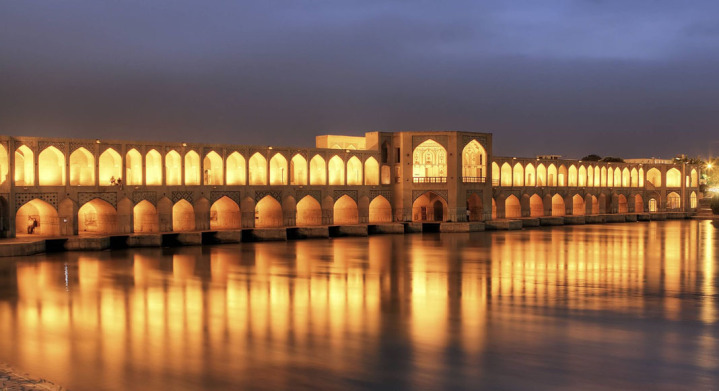
The Siwase Bridge or Allahverdi Khan Bridge is a 33-span, 295-meter-long, and 14-meter-wide bridge built under the supervision of Allahverdi Khan Ondiladze and with the architecture of Ostad Hossein Bana Isfahani over the Zayandeh River in the city of Isfahan during the reign of Shah Abbas I. It was the place where the Abpashan festival and the Khujushyan ceremony of the Armenians of Isfahan were held during the Safavid era. The idea of building the Siwase Bridge was conceived in 1008 AH, the twelfth year of the reign of Shah Abbas I, and in 1011 AH, Allahverdi Khan Ondiladze, his famous Georgian general, was commissioned to complete the construction of the bridge. References to this festival have been made in the travelogues of European travelers of that time. In this celebration, held on the 13 th of July every year, people participated in the ceremony by sprinkling water and rose water on each other. The Armenians of Jolfa, Isfahan, also held their Khajshuyan ceremony within the boundaries of this bridge. This bridge is considered one of the masterpieces of Iranian architecture and bridge construction and has a unique beauty and grandeur.
Percy Sykes called the Siwase Bridge one of the first-class bridges in the world, Chardin called it an architectural masterpiece and a marvel, and Dan Garcia called it one of the best works of Iranian architecture. And in the words of Lord Curzon, "One does not expect to have to travel to Iran to see what can be called the most magnificent bridge in the world." Dan Garcia writes about this: "This bridge is also one of the buildings of Allahvardi Khan Gorji, and although his enemies and ill-wishers say that this building was built with money, they cannot deny that it was his own builder. But the general public believes that Allahvardi Khan built the bridge at his own expense."
One of the poets of the Safavid era, Ali Naghi Kamarai, has calculated the date of the construction of the bridge in a poem in the form of a historical article, as the year 1005 AH, and this year is exactly the same as the days when the unique Chaharbagh Street was also built. The Siwase Bridge connects the Abbasi Chaharbagh to the Upper Chaharbagh.
This work was registered on 15 Dei 1310 with registration number 110 as one of the national monuments of Iran.
According to experts in geology and cultural heritage, the materials, base, and foundation of this bridge are designed in such a way that its strength is only in moisture, and the continued dryness of the river in the long term poses a great risk to the Siwase Bridge.
Comment