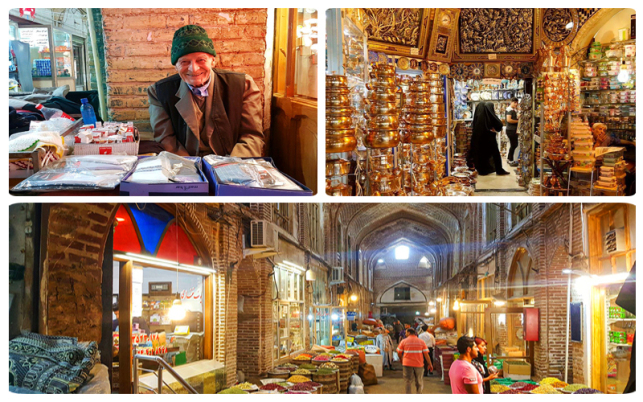
تجربه را سفر کنین
Travel the experience
Zanjan market
Zanjan Bazaar is the longest covered market in Iran. This market began during the reign of Agha Mohammad Khan Qajar and ended in 1213 during the reign of Fath Ali Shah Qajar, and mosques, houses, and baths were added to it in 1324 AH. The old market complex is divided into two parts, the upper and lower markets, in a straight line into the eastern and western parts. The geographical spread of Zanjan Bazaar and the diversity of the orders, the number of houses and inner-city caravanserais in the sub-orders, each of which is dedicated to a specific name and activity, and the presence of many mosques indicate the dynamism of this complex throughout the past and the prevailing conditions. This market expanded from the west and east, and in this regard it was divided and named the lower market and the upper market.
History
The construction of Zanjan Bazaar began in 1205 AH during the reign of Agha Mohammad Khan Qajar and ended in 1213 AH, coinciding with the reign of Fath Ali Shah Qajar. In later periods, several additions were made to the Zanjan Bazaar, including the construction of several houses, mosques, and baths.
The orders
The Zanjan Bazaar is divided into eight orders in terms of production and type of activity, including the orders of goldsmiths, shoemakers, bazaars, saddlers, and several other orders. Among the caravanserais in this complex, which played an effective role in the supply of goods in the past, are the Haj Ali Qoli Caravansary or House and the Haj Karbalai Ali Caravansary.
Architectural techniques and styles
The architectural techniques, styles, and decorative methods of the Qajar era were beautifully implemented in the orders, rooms, squares, mosques, houses, and inner-city caravanserais, and baths. These techniques include: the use of various types of crescent, lancet, and lancet arches, and special cradle arches in the main and secondary rows, decorated with porcelain bricks with various geometric designs such as lying, row, and wickerwork, and the use of old-style bricks and tiles, and tiling in Qajar colors and designs on the exterior and interior surfaces of buildings, arches, arches, and flower-filled columns. The peak of these architectural styles, methods, and decorative innovations has emerged in the components and pillars of Zanjan's historical mosques, especially the Zanjan Grand Mosque.
The Zanjan Bazaar complex has been registered in the list of national monuments of Iran.
Address: Zanjan, Railway, Revolution Square, South Saadi Street
Comments